
Introduction
A yard that has never been properly planned doesn’t stay neutral; it actively works against you. Soil compacts, drainage fails, and foundation plantings begin crowding each other out after just fifteen years. Homeowners who ignore deliberate landscape planning always spend a lot more money fixing an unplanned space than they would have spent putting into a proper landscape design from the beginning. The American Society of Landscape Architects confirms that well-designed landscapes can increase resale value by up to 15%, and a neglected one pulls it the other direction.
Brookside Landscape & Design helps homeowners across Kitsap County stop that cycle before it becomes irreversible.
This guide covers everything you need before touching a single shovel, from reading your site correctly and choosing a landscaping style that fits your property, to the design mistakes that quietly ruin good yards and the features that meaningfully add value.
Understanding the Purpose of Your Landscape Design
The biggest reason outdoor landscape design projects underdeliver is that they begin without a defined purpose. Function must come before aesthetics, every time.
Form Follows Function: Define Your Outdoor Goals First
The yard may need to handle a sloped lot that floods every wet season, create a private retreat from neighboring properties, or serve as a functional space for entertaining, and the design should reflect whichever of those it is. The answers shape every decision that follows. Landscaping goals fall into four categories:
- Functional: Drainage control, erosion management, and grading on difficult lots
- Recreational: Open lawn, fire pit areas, and space for children
- Aesthetic: Curb appeal, seasonal color, and visual cohesion with the home’s architecture
- Ecological: Native plantings, water conservation, and sustainable design
A yard attempting all four without intentional landscape planning usually accomplishes none of them well.
Evaluating Your Outdoor Space Before Designing
Most design failures are not design problems, but site evaluation problems that show up too late.
What a Real Site Assessment Covers
| Evaluation Factor | What Happens If You Skip It |
| Soil composition | Plants fail; lawn establishment collapses |
| Drainage and grading | Water pools near foundations; erosion follows |
| Sun/shade mapping | Wrong plants die in the wrong spots |
| Mature plant spacing | Overcrowding causes competition and decline |
Properties in Hansville, Port Ludlow, WA, and coastal Bainbridge Island frequently present heavy clay soils and slope-related drainage challenges. In these areas, bypassing soil evaluation guarantees problems in the first two to three years of cultivation. The quality of any landscape installation stems directly from how well it’s established in the soil beneath it, not what’s placed on top.
A yard that looks good on day one but wasn’t built on a sound site plan will cost you twice, once to install and once to fix.
Choosing the Right Landscaping Style for Your Property
Never choose a landscape design style in isolation without the home it adjoins. A designed yard has style coherence. A decorated yard does not.
Matching Style to Architecture and Climate
The Pacific Northwest’s wet winters and clay-heavy soils make certain landscaping ideas more successful than others:
- Pacific Northwest Native: Plants like Oregon grape and sword fern perform naturally here, requiring less water and less intervention than ornamentals from drier climates.
- Modern Minimalist: Structure and limited plant palette in hardscaping. Great for residential landscaping in Silverdale and Bremerton, where curb impact is a consideration.
- Outdoor Living-Centered: Emphasis is on patios, pergolas, water features, and planting to frame the space. A strong fit for Gig Harbor properties.
- Cottage/Naturalistic: Layered perennials and informal pathways that suit wooded lots in Poulsbo and Kingston, WA.
The wrong style creates maintenance burdens the homeowner is not prepared for. Style should be according to the climate, not preference.
How to Select the Right Plants and Materials
This is where most DIY backyard landscaping projects go wrong, and where the gap between a professional result and an amateur one is most visible.
Plant Selection: The Climate-First Approach
The Pacific Northwest falls largely in USDA Hardiness Zone 8b. Within that zone, soil type and microclimate can vary significantly even within a single property in Port Orchard or Port Ludlow, WA. Key principles:
- Group plants by water need; mixing drought-tolerant natives with thirsty ornamentals creates irrigation inefficiency and plant stress.
- Design for mature size, not install size. A plant that looks sparse at 18 inches will crowd its neighbors at 6 feet within three years.
- Layer for year-round structure, evergreen anchors, a deciduous mid-layer, and seasonal groundcover keeps the landscape visually strong across all four seasons.
Materials That Hold Up in the Pacific Northwest
| Material | Best Use |
| Permeable pavers | Patios and walkways, manages stormwater on wet lots |
| Natural stone | Retaining walls and borders, durable, complements native plantings |
| Local aggregate | Drainage beds and pathways, integrates naturally |
Common Landscape Design Mistakes to Avoid
Across hundreds of professional landscaping projects in Bainbridge Island, Gig Harbor, and the wider Kitsap region, the same costly patterns appear repeatedly.
The Mistakes That Follow Homeowners for Years
- Planting without drainage infrastructure. Drainage is invisible once the landscape is installed, but its absence is felt every wet season. It must be designed before any landscape installation begins, never as an afterthought.
- Choosing plants for appearance at the nursery: A plant that is in its prime at the garden center may be completely unsuitable for a shady, clay-heavy backyard. Aesthetics must be paramount to site conditions.
- Crowding at the installation for immediate impact: Plants installed too close look lush for two seasons, then compete, leading to disease, stunted growth, and costly removal.
Good landscape design is invisible. You don’t notice what it does right. You only notice when something was done wrong.
Why Professional Landscape Design Matters
The difference between a well-maintained yard and a designed yard is immediately obvious, and the long-term cost difference is huge.
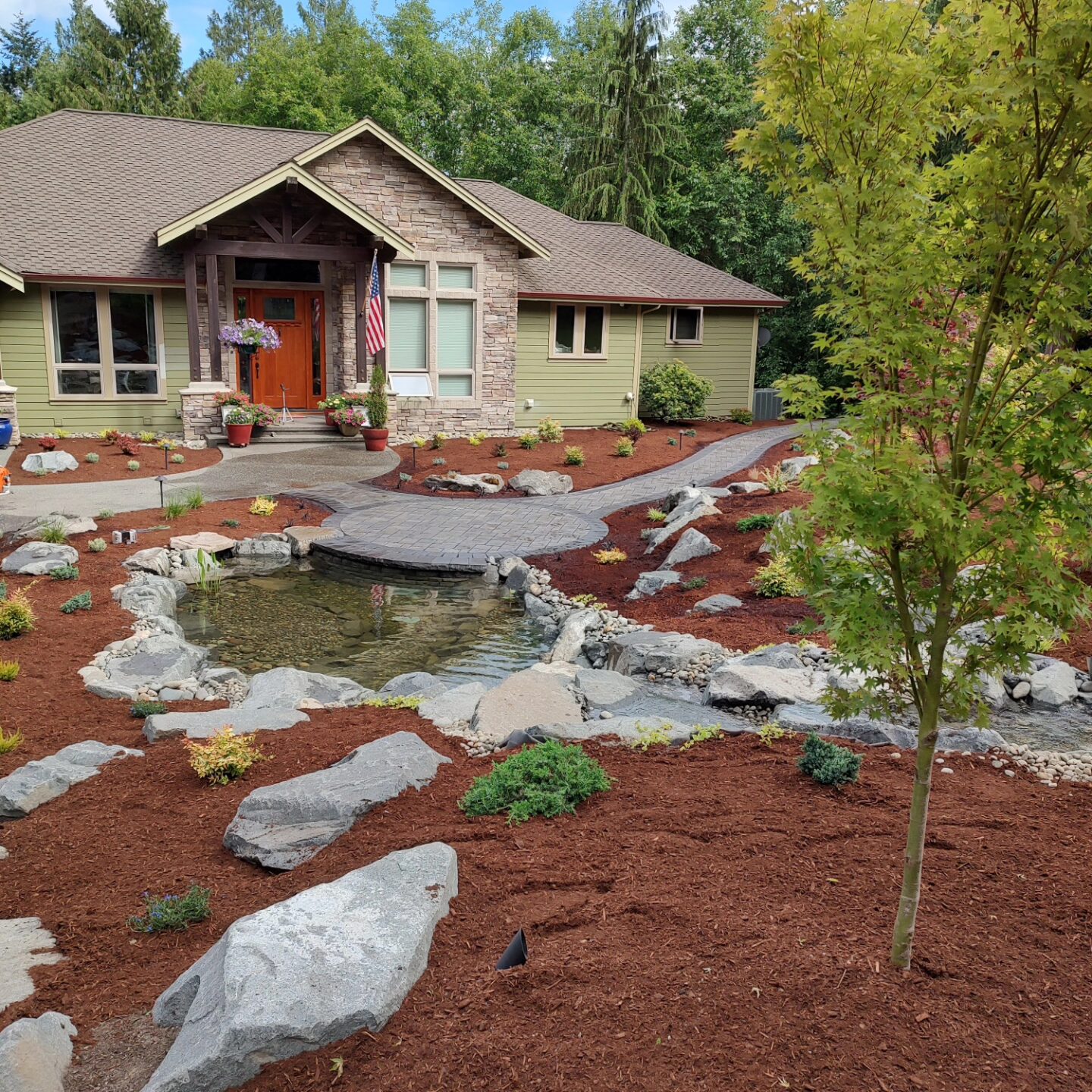
We operate on a principle we call People, Process, Product: the right people, following a sound process, consistently deliver a product that holds up. With a combined 25 years of experience, our team brings site-specific expertise that protects clients from the mistakes that underqualified contractors routinely produce. Our landscaping services cover the full scope of what a property needs, from outdoor landscape design and hardscaping to water features, retaining walls, and every element in between. Everything in the landscape, from the most striking building to the last shrub, has been made for the others.
Landscaping Features That Increase Property Value
Research from Virginia Tech found that high-quality landscaping can increase a home’s perceived value by 5–11%. The features that consistently drive that return:
- Hardscaping: Patios, walkways, and retaining walls are functional improvements with lasting appeal
- Water features: Garden ponds and fountains carry strong buyer appeal in premium markets
- Professional lawn installation: A quality lawn established correctly in the soil outperforms any surface-level fix
- Native and sustainable planting: Low maintenance requirements signal long-term value to buyers
Across Bremerton, Silverdale, Poulsbo, and Hansville, the properties that generate the strongest responses are the ones where hardscape and planting work together as a cohesive system, not as separate decisions made at different times.
Your Landscape, Built to Last
Every principle in this guide leads to the same conclusion: a landscape that functions well, holds its value, and remains manageable is the result of deliberate planning, not inspired impulse decisions. Drainage must come before planting. Style has to serve the climate. Materials must be compatible with the homeowner’s architecture and commitment to maintenance. If you miss one of these, the landscape will eventually show you exactly where you stopped planning.
At Brookside Landscape & Design, we serve homeowners across Bremerton, Bainbridge Island, Gig Harbor, Hansville, Port Orchard, Poulsbo, Silverdale, Kingston, WA, and Port Ludlow, WA with landscaping services that span outdoor landscape design, landscape planning, landscape installation, lawn establishment, water features, hardscaping, and modern landscape design. We work gently with the environment to deliver results that are durable, sustainable, and genuinely beautiful, backed by 25 years of combined field experience.
If your yard has been waiting for a plan, now is the right time to build one. Call Brookside Landscape & Design today at (360) 434-6102 and let’s design an outdoor space that works for your property, your climate, and your life.