
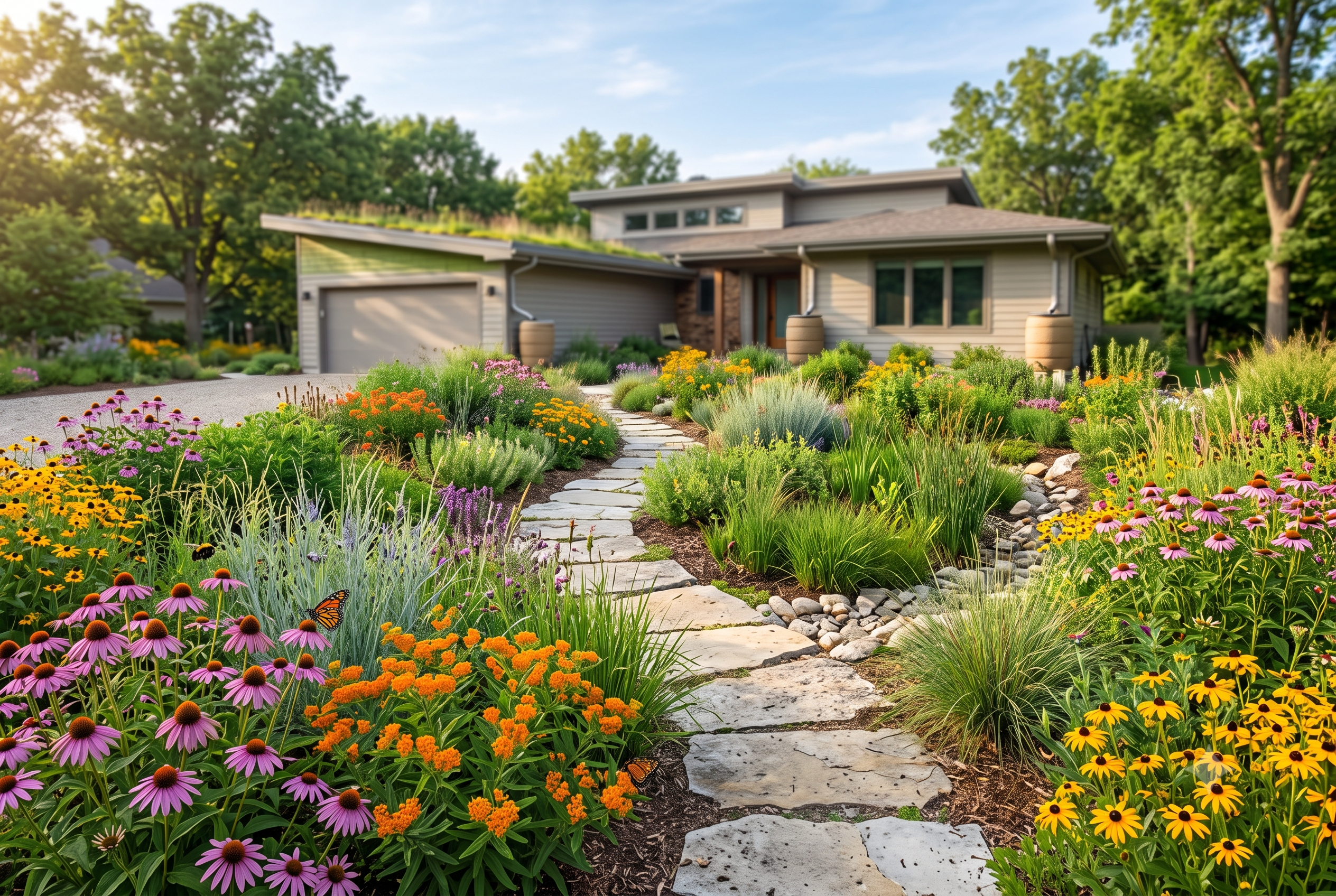
Every yard tells you something if you’re willing to pay attention. Maybe it’s the corner that stays soggy long after the rest of the property has dried out, or the strip along the driveway where nothing survives past July. Homeowners working with a landscaper in Bremerton, Bainbridge Island, Gig Harbor, Hansville, Port Orchard, Poulsbo, Silverdale, Kingston, and Port Ludlow, WA know this pattern well, because Western Washington doesn’t play by one set of rules: winters are generous with rain, summers are not. Washington State University notes the Puget Sound region typically sees only 3 to 4 inches of rainfall across the entire summer, meaning a landscape that looks lush in April can struggle by August without the right plan behind it.
That’s the starting point for sustainable landscaping in 2026: choosing plants and layouts that fit the conditions they’ll live in, so the landscape doesn’t need constant rescuing.
A sustainable landscape isn’t a smaller version of a traditional one. It’s a smarter one.
Why Are Native Plants Better for Western Washington Landscapes?
Native plants have had thousands of years to adapt to this region, a head start imported species don’t have. That doesn’t mean every native plant belongs in every yard, though. WSU is clear: plant selection should come back to the site itself- soil, sunlight, water access, existing pests- not just a plant’s native status. Native is a good starting filter, not a finish line.
A sun-drenched property in Port Orchard and a shaded lot in Poulsbo won’t want the same plant list. A waterfront yard in Gig Harbor deals with different drainage than a property a few miles inland.
What native plants tend to offer, when matched properly to a site:
- Better adaptation to the region’s rainfall and temperature swings
- Support for local pollinators, per the National Park Service
- A more natural fit with waterwise planning, needing less supplemental irrigation once established
- A landscape that feels like it belongs here
- Plenty of room for color, texture, and structure; sustainability doesn’t mean giving up curb appeal
Quick tip: Don’t assume a plant is low-maintenance just because it’s labeled “native.” WSU notes native species vary widely in water needs; grouping by need matters more than the label alone.
How Do Climate-Ready Gardens Actually Work?
“Climate-ready” sounds like a buzzword, but the idea is simple: design the yard around the weather it will actually experience, not how it looks on installation day. Most Kitsap-area properties aren’t one uniform environment; there’s usually a mix of full sun, shade, low spots that hold water, and slopes that erode a bit more each winter. A climate-ready approach treats those differences as design information instead of ignoring them.
| What to look at | Why it matters |
| Sunlight exposure | Determines which plants thrive versus struggle in each zone |
| Soil drainage | Shows where water pools and where it disappears too fast |
| Water needs | Groups plants so irrigation isn’t wasted on the wrong areas |
| Slopes | Planting can help stabilize soil that would otherwise erode |
| Seasonal change | Keeps the yard from looking good one month, bare the next |
| How the space is used | Lawn, gathering areas, and privacy shape what gets planted where |
WSU’s waterwise guidance recommends organizing a landscape into irrigation zones based on how much water each section genuinely needs, rather than watering the whole property on one schedule.
This is where a well-rounded landscape design earns its keep. Brookside Landscape & Design’s installation work pairs planting with water elements, retaining walls, walkways, and patios, all built with sustainability in mind. For someone researching a landscaper in an area like Bremerton, the real question isn’t “which plants should I buy?” It’s “how should this whole property work together?”
How Do Native Plants Help Save Water?
Here’s a misconception worth clearing up: planting native species doesn’t mean you can forget about watering. Even drought-tolerant plants need consistent water during their first growing season, per WSU. The payoff comes later, once roots are established.
The bigger picture matters too. The EPA estimates residential outdoor water use accounts for nearly 8 billion gallons per day nationwide, and that as much as half of that is wasted through overwatering and inefficient irrigation. (EPA WaterSense)
Habits that actually cut down on wasted water:
- Match the plant to the spot. A moisture-loving plant doesn’t belong in your driest corner.
- Group by water needs. WSU recommends zoning plantings so high- and low-water areas aren’t on the same schedule.
- Treat new plantings differently than established ones. A six-month-old landscape needs more attention than a three-year-old one.
- Look at the irrigation system itself. Outdoor use makes up roughly 30% of household water use nationwide, per the EPA. (EPA WaterSense)
Sustainable landscaping isn’t only about what you plant. It’s also about how the water gets to it.
Why Are Native Plants the Future of Sustainable Landscaping in 2026?
The bigger shift happening in landscaping right now isn’t about any single plant list; it’s about designing yards that respond to where they actually are. Homeowners want outdoor spaces that look good and don’t demand constant upkeep, and native, regionally appropriate plants check both boxes when chosen thoughtfully.
For residents comparing options for a landscaper in Bainbridge Island, this regional knowledge shows up directly in the work. Brookside’s Bainbridge Island service page speaks to the island’s soil, climate, and native plant considerations. The same logic carries across the region: a landscaper in Silverdale may face different site conditions than a landscaper in Hansville, and a landscaper in Port Orchard could have entirely different priorities than a landscaper in Gig Harbor.
The old way versus the better way:
| Old approach | More sustainable approach |
| Pick plants that look appealing at the nursery | Assess the site first, then choose what will thrive |
| Water everything on the same schedule | Group plants by water needs and irrigate accordingly |
| Fix problems after they show up | Design around seasonal conditions from the start |
Treat the yard as one space.
Treat sun, shade, slope, and drainage as separate zones
Done well, this produces a landscape that’s polished and intentional, not sparse or wild-looking.
What Sustainable Landscaping Trends Will Shape 2026?
A few ideas keep showing up across the region this year:
- Waterwise planting: matching plants and irrigation to real site conditions, as WSU recommends.
- Native and regional plants used thoughtfully: chosen for the specific property, not a blanket solution.
- Outdoor spaces built for actual use: patios, walkways, and lawns that get lived in.
- Hardscaping that pulls weight: pavers, flagstone, and retaining walls that reduce upkeep while adding structure.
- Landscapes built for the long run: fewer disconnected features, more of a plan where everything works together.
If there’s one word that sums up 2026, it’s intentionality.
Why Choose Eco-Friendly Landscaping?
A yard doesn’t exist in isolation; it interacts with rainfall, soil, neighboring properties, and passing wildlife, which is why local context matters so much in landscape planning.
Our landscapers at Brookside Landscape & Design serve communities across Bremerton, Silverdale, Gig Harbor, Port Orchard, Bainbridge Island, Poulsbo, Port Ludlow, Port Townsend, and Seabeck. We have served clients since 2016 and bring 25 years of combined landscaping experience to our projects. For anyone researching a landscaper in Poulsbo, Kingston, WA, or inPort Ludlow, WA, that regional familiarity shapes the planning process in ways a general contractor can’t replicate.
Our services include landscape installation and renovation, water features, lawn installation, hardscapes (pavers, flagstone, fire features), artificial turf installation, retaining walls, irrigation installation, landscape lighting, and outdoor audio.
A few factors tend to shape how a project comes together: property size and slope, existing soil and drainage, how much space needs hardscaping versus planting, and which features, like water elements or lighting, are part of the vision.
Before starting a sustainable landscape project, it’s worth asking:
- Does the plant selection fit this property’s sun, soil, and water conditions?
- Are plants grouped by water needs?
- Can the design hold up through a dry Western Washington summer?
- Does the layout match how the household actually uses the yard?
The Landscape of Tomorrow Starts With the Land You Have Today
Native plants aren’t a shortcut, and sustainable landscaping isn’t about making every yard look identical. The strongest results come from understanding a property first, then building a plan around its water, sunlight, and soil.
For homeowners working with a landscaper in Bremerton, Bainbridge Island, Gig Harbor, Hansville, Port Orchard, Poulsbo, Silverdale, Kingston, and Port Ludlow, 2026 is a good moment to move past “make the yard greener” and start building a landscape that genuinely works for where it sits.
If that’s the project you’ve been putting off, Brookside Landscape & Design at (360) 434-6102 can help turn it into something real, built around your property and the Pacific Northwest it calls home.